



How Kwala shipped its developer documentation using the Diátaxis framework
Learn how Hackmamba helped Kwala deliver workflow-driven developer documentation on Mintlify and a clear, investor-ready whitepaper that supported faster onboarding and product understanding.

Key outcomes
- Released usable documentation on Mintlify that supported engineers ahead of the project deadline
- Structured documentation around the workflow builder to reflect how developers use Kwala in practice
- Delivered a whitepaper with a custom diagram to support investor and enterprise evaluation
Company snapshot
Kwala is a developer-focused platform built by MAI Labs. It enables developers to connect real-world events such as APIs, off-chain data sources, and external system triggers to blockchain-based workflows. The platform is designed for external developers building automation on top of blockchain infrastructure. A key part of the platform is the workflow builder, which abstracts the underlying YAML-based automation logic.
- Industry: Web3
- Company size: 51–200 employees
- Location: Noida, India
- Use case: Documentation setup, developer onboarding, information architecture
- Product: Kwala workflow automation platform
The challenge
Kwala’s existing documentation was limited to basic introductory instructions and did not reflect how developers actually use the platform. Key use cases were missing, and recent product developments were not documented.
A major gap was the absence of documentation for the workflow builder, which had become a central part of the platform. Developers had no clear guidance on how to use it or how it related to the underlying YAML-based automation.
At the same time, the documentation needed to serve different audiences. External developers required practical guidance to get started, while investors and enterprise stakeholders needed a clear explanation of Kwala’s direction and capabilities. Balancing these needs without overloading a single set of documents was a core challenge.
Our approach
We started with a documentation audit to understand what already existed and what needed to change. This helped identify gaps around use cases and recent platform developments.
To understand the platform in depth, we reviewed a live product demo and studied existing walkthrough videos shared by the Kwala team. Ongoing async discussions and regular syncs helped clarify workflows, terminology, and developer expectations.
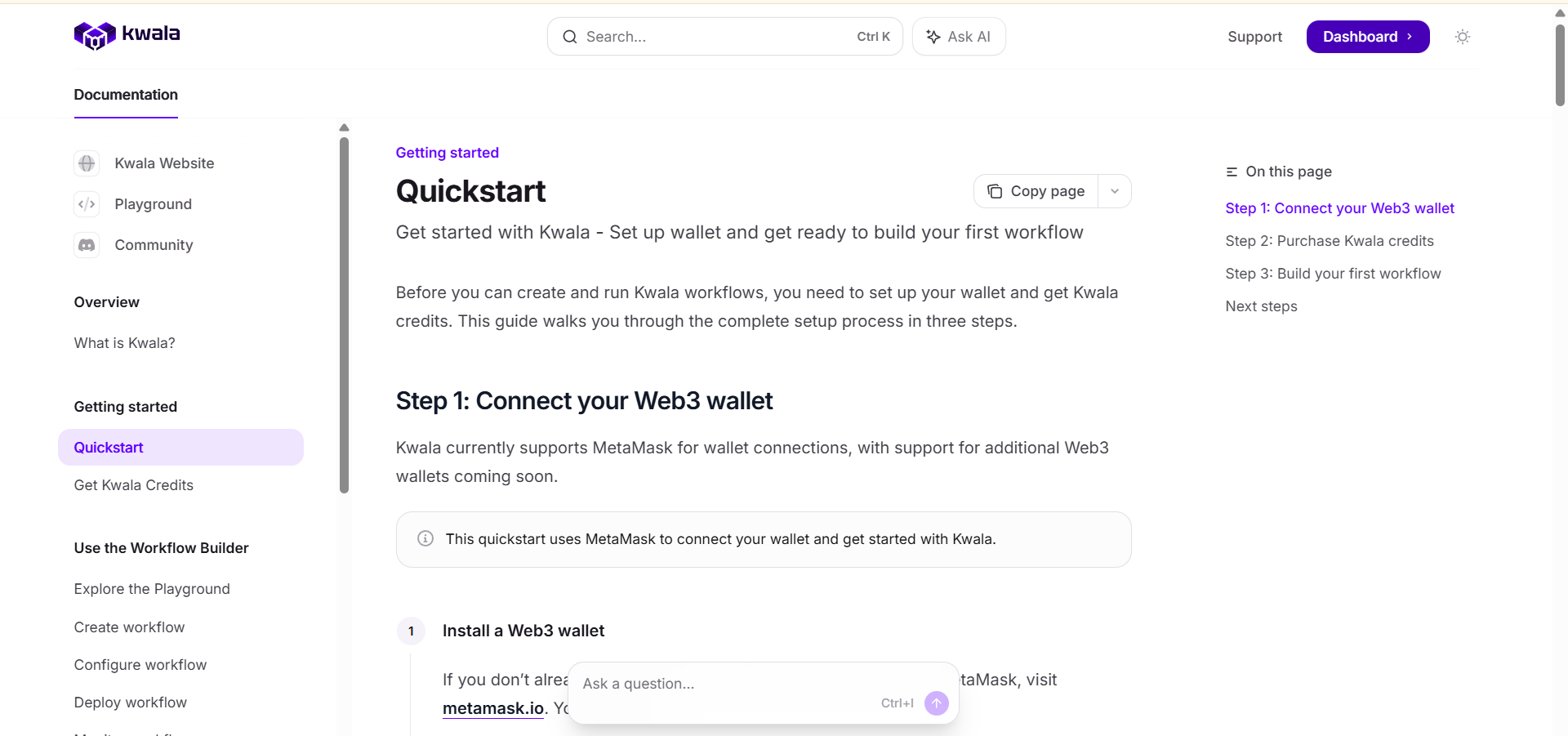
We redesigned the information architecture using the Diátaxis framework and implemented it on Mintlify. Documentation was structured around the workflow builder, with content written to guide developers from onboarding to implementation. In parallel, we worked on a whitepaper tailored for investors and enterprise stakeholders, including a custom diagram to explain the system at a high level.
Final thoughts
This project reinforced the importance of strong initial guidance when working on developer documentation. Sharing progress frequently helped align expectations and made it easier to adapt as the documentation took shape.
As our documentation manager noted:
We took a look at Kwala’s existing documentation and quickly realized sticking to the basics can deliver great results. Reinventing the wheel is unnecessary in projects like this.
This approach allowed the team to focus on clarity and usability while building a documentation foundation Kwala can continue to expand.
If you are building a developer-focused product and need technical documentation services, Hackmamba can help with developer documentation, onboarding, and information architecture. Book a call today.