



Is your AI search optimization missing developer behavior?
If your AI search optimization stops at rankings, you’re missing how developers choose what to trust. Here’s why behavior must guide strategy.


Developers don’t search like general users. They debug across tabs, test edge cases, and save references for reuse. AI search systems reassemble content into unified answers. This creates a challenge for every piece of technical content.
The value of technical content is shaped by how it fits into practical workflows. What gets reused is what resolves ambiguity, supports edge cases, or exposes trade-offs. What gets bookmarked is what carries enough context to stand on its own.
Most optimization efforts focus on visibility, but retrieval isn’t the same as utility.
In this article, I argue that AI search optimization fails when it ignores how developers evaluate and use information. You’ll see how AI systems assemble answers, how developer behavior defines what content holds up, and why strategy needs to account for more than retrieval.
The following article in this series covers the structural steps to create content that survives compression and earns clicks.
Read: Practical AI search optimization guide for technical content (+ 7 Tips)
What the AI search system prioritizes
AI search systems follow a predictable structure. The backend uses traditional search infrastructure, which involves crawling pages, indexing content, retrieving matches, and ranking results. These steps determine what gets pulled into an answer.
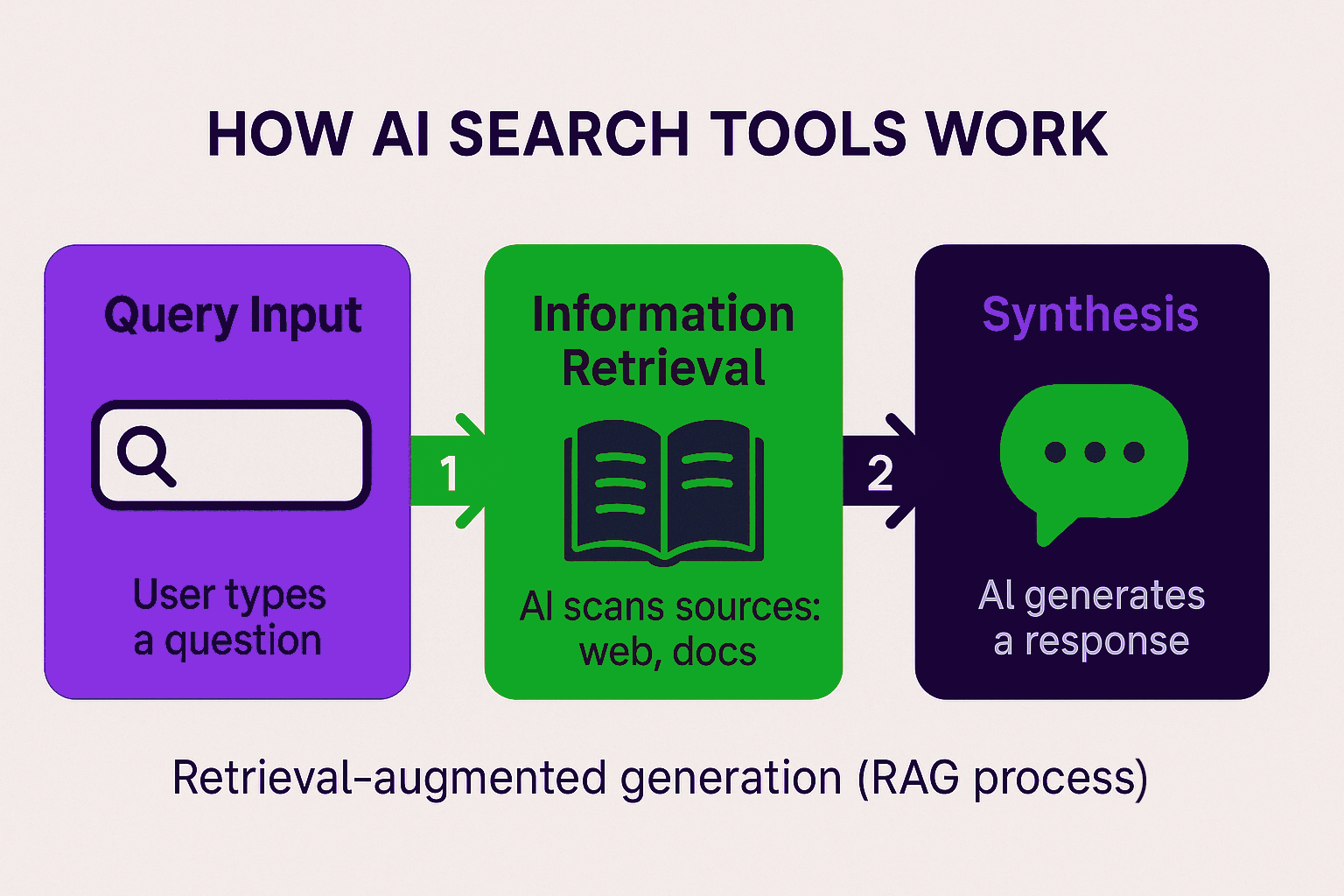 Dan Petrovic captured this cleanly. He referred to the model as a presentation layer. The AI search engine underneath controls what gets selected. The model determines how it's displayed.
You can see how this structure rewards repeatability. If a setup process is documented across hundreds of pages, retrieval will locate it, and the model will present it in a clean, familiar format. In our tests, basic queries, such as how to set up a Python virtual environment, were processed without issue through this system. The index had enough examples, and the model simply rephrased what was already available.
We noticed something different when we inquired about contributing to Nextcloud’s documentation. That example is covered in detail in the second article. In short, the response followed the standard Sphinx workflow. The retrieval layer matched common patterns, but the result didn’t reflect how Nextcloud’s docs work.
What the system prioritizes is frequency. It retrieves the information that has been documented the most and reshapes it for readability. If your content doesn’t reflect that pattern, it doesn’t get pulled. If your documentation addresses edge cases, version quirks, or integration traps, the system won’t surface it unless that information is already prominent in the index.
The nine-step process for building content that satisfies both traditional search and AI search is covered in the SEO for developer tools guide.
Why AI search misses developer-specific context
Most developer content doesn’t follow a fixed structure. Even when tools are well-documented, the way developers use them tends to vary across versions, environments, and implementation constraints. That variation shows up in edge cases, custom setups, integration gaps, and unexpected interactions between tools. These are the conditions where developers need precision.
The system often returns the most common setup, which may look correct but misses the details needed for a specific environment.
Failures often show up as overlooked dependencies or incorrect commands, which slow down debugging.
What’s missing here is visibility. Most of the content that covers edge conditions, decisions, and constraints isn’t repeated often enough to be retrieved. Even when it is, the model may not identify which parts are important.
To understand the impact, consider how developers evaluate and use content in their practice.
How developers consume content
Developers look for content they can trust, apply in their environment, and return to later. The daily.dev survey on technical content consumption confirms this, showing that trust, precision, and reusability are central to their habits.

The content and community strategies that align with this consumption behavior are covered in developer marketing strategies, with examples from Stripe, Twilio, and Postman.
Trust through social proof
Answers are rarely taken in isolation. Developers often rely on what their peers share in Slack, Discord, GitHub issues, or internal threads. The survey found that 72% share content with coworkers and 52% with friends, showing that validation often comes from trusted circles. When a teammate or community contact shares a solution, it carries weight because it comes from someone who has tested it in a similar stack.
Video is specifically how developers gain deeper conceptual understanding beyond what text alone delivers. What they expect from technical video - and how to produce it so it earns sharing - is covered in the developer video content guide.
Precision over convenience
A quick summary is helpful for syntax, but debugging requires precision. A fix only works if it matches the version, configuration, and error at hand. If they're debugging WebSocket connection failures behind a reverse proxy. They want the exact nginx configuration fix for your setup, with version details and error codes included.
The survey highlighted that 54% of developers prefer documentation as their top source because it provides the depth needed to handle specifics. Generic overviews are less useful without the context that developers rely on.
Reusability and reference value
Developers bookmark, star, and save resources for reuse in future projects. The survey showed that 85% want a central place to keep all the content they’ve shared. That suggests a workflow based on a reference value. AI answers, by contrast, are ephemeral, generated once, then gone. They don’t fit naturally into this reference-heavy workflow.
So, what does this mean for technical content?
Implications for technical content in AI search
To align with how developers evaluate information in AI search, your content strategy should:
- Prioritize usability: Create resources developers can apply directly in their workflows.
- Include the details that build trust: Preserve logs, error messages, screenshots, benchmarks, and trade-offs that validate the information.
- Show decision context: Explain what was chosen, what alternatives were considered, and why a particular approach was recommended.
- Reduce context loss: Ensure key information is present on the page so the content remains useful even when summarized by AI systems.
These principles increase the likelihood that your content is cited, referenced, and trusted by both developers and AI search engines. The challenge is putting them into practice consistently across documentation, tutorials, comparison pages, and technical guides.
The next article in this series covers the practical side of AI search optimization, including how to structure content, documentation, and developer resources so they survive compression and earn visibility in AI-generated responses.
If you're looking for help implementing these strategies, Hackmamba is an SEO agency for devtools. We help developer-focused companies build technical content, documentation, and search programs that drive visibility across both traditional search engines and AI-powered search experiences.
Finally, visibility only matters if it leads to meaningful outcomes. Measuring whether your content is reaching developers at the right moment, from search impressions and engagement to product activation and adoption, is covered in the developer marketing metrics guide.