



How and where to hire a technical writer: complete guide
Compare the three models for hiring a technical writer: full-time, freelance, and agency, with cost breakdowns, platform rankings, and interview questions for each.

You are here because you searched for "where to hire a technical writer" or "hire a technical writer." You would have noticed that most of the results on the first page are not guides but listings or service pages. They lead to freelance marketplaces, job boards, or recruiter platforms.
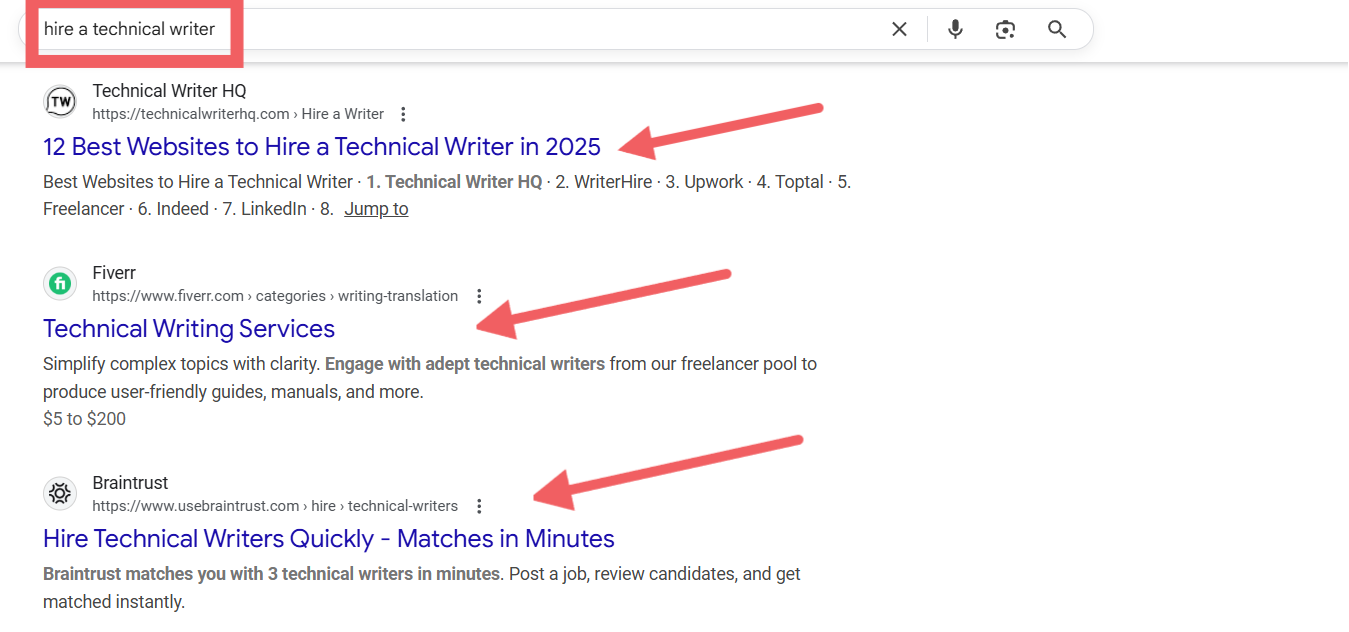
These search results tell you where to find technical writers but skip what actually matters: hiring a technical writer is about creating a system that keeps product knowledge clear and accessible. Done well, it speeds up releases, reduces dependency on engineers for explanations, and lowers support load. Done poorly, it creates confusion, slows adoption, and adds more work back to the product team.
How to hire a technical writer
To hire a technical writer, choose between three models: a full-time in-house hire for ongoing documentation needs, a freelance writer from platforms like Upwork or Toptal for short-term projects, or a specialized agency for continuous, technically accurate documentation without the overhead of recruiting and managing individual writers. The right model depends on your documentation volume, product complexity, and internal bandwidth.
There are three established models for hiring technical writers. Some technical product companies hire full-time writers, others depend on freelance marketplaces, and many turn to specialized agencies built for technical writing. Each approach serves a different purpose and comes with specific trade-offs in cost, control, and output quality.
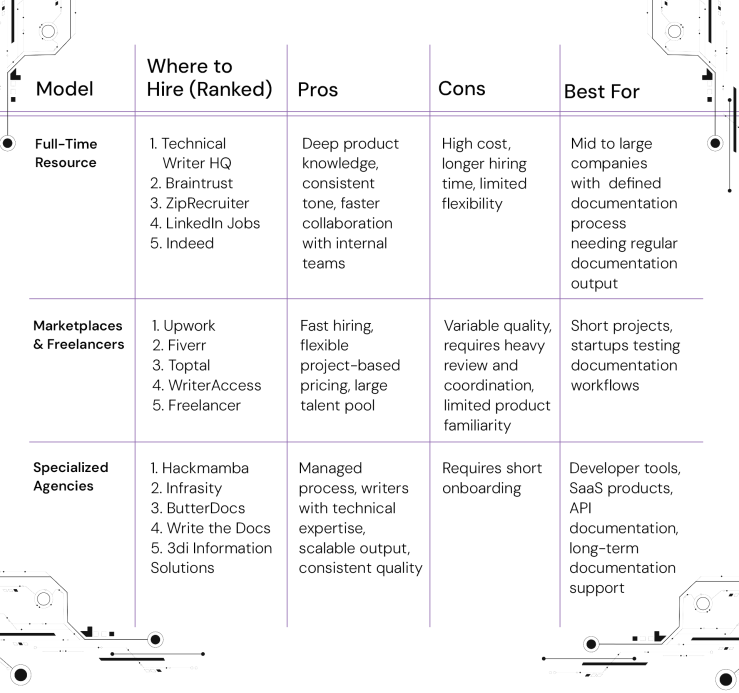
In this guide, we will look closely at how these three models work, what their hidden costs are, and where it makes sense to invest.
The three models for hiring technical writers
Option 1: Hire a full-time resource
Hiring a full-time technical writer means bringing technical expertise in-house. This model gives you someone who works closely with product and engineering teams, understands the product deeply, and manages documentation as an ongoing process. It is most effective for teams with a steady flow of technical content, such as frequent releases, complex systems, or multiple integration points.
Pros, cons and who is it for?
| Pros | Cons | Best for |
|---|---|---|
| Builds long-term familiarity with the product and workflows | High hiring and retention costs | Mid to large companies with regular documentation output |
| Ensures consistent tone and structure across documentation | Limited flexibility when documentation needs fluctuate | Products with continuous updates or complex architectures |
| Faster coordination with product and engineering teams | Hard to find writers with both technical depth and communication skills | Teams that already have a defined documentation process |
| Immediate access to update content during releases | Requires management oversight and onboarding effort |
Where to hire (ranked)
- Technical Writer HQ
- Braintrust
- ZipRecruiter
- LinkedIn Jobs
- Indeed
What to look out for?
One writer on Reddit summarized it well:
There are two things you want to look for in a technical writer: Are they good at figuring things out on their own? Can they convey things clearly, simply, and logically?
That is exactly what many technical product teams look for when hiring. The best technical content writers translate complex technical information with clarity.
You can evaluate candidates with these five questions:
- Can they learn new systems quickly?
- Is their technical writing clear and accurate?
- How do they organize and maintain documentation?
- How do they collaborate with engineers and subject matter experts?
- Can they maintain quality over time?
Option 2: Hire freelance writers from marketplaces and freelance platforms
Hiring freelance technical writers from marketplaces is the fastest way to get started, but they work best for short-term projects. You post a job, review profiles, and hire based on ratings or samples. Most technical writers on these platforms work with multiple clients, which limits how much product context they retain.
The work usually starts strong but needs careful review. These freelance writers depend on your brief most of the time, and without a clear roadmap for the content, the accuracy drops. If your documentation involves APIs, SDKs, or internal systems, be prepared to spend time clarifying information and correcting drafts.
Pros, cons and who is it for?
| Pros | Cons | Best for |
|---|---|---|
| Quick access to available writers | Inconsistent quality across writers | Startups documenting small features or updates |
| Flexible pay per task or deliverable | Limited understanding of product or codebase | Companies testing documentation workflows |
| Useful for patching gaps in documentation | Requires heavy review and feedback cycles | Teams with technical staff available for review |
Best platforms to find freelance technical writers (ranked)
What to look out for?
Before hiring a freelance technical writer, check whether the writer can handle technical material without step-by-step supervision. Ask them to explain a product feature in their own words or to rewrite an existing help article. Make sure they have strong research skills and can work independently.
Ask these five questions before hiring:
- Can they learn your product quickly and explain it clearly?
- Do they ask precise, relevant questions about the feature?
- Can they follow your documentation format without training?
- Are they familiar with your tools like Git or Markdown?
- Do they deliver error-free drafts within deadlines?
Marketplaces are best used for defined, one-off technical writing tasks. For ongoing documentation, they need strong internal review and coordination to maintain quality.
Option 3: Work with specialized agencies
Agencies that focus on technical writing bring structure, quality control, and subject matter expertise. They operate with defined processes, experienced writers, and editors who manage consistency across projects. For teams that need documentation to keep pace with development, this model removes the need to recruit, train, and manage individual writers.
The effectiveness of this approach depends on who you choose to work with. Many agencies list technical writing as a service, but only a few have writers who understand engineering concepts, developer tools, and product workflows. A strong technical writing agency combines writing skill with technical knowledge.
Hackmamba is one of the few agencies built around this model. Every article, guide, and API documentation piece is written by technical writers who are engineers first, with deep familiarity in technologies like React, Java, C++, Python, and various API frameworks. They understand how technical systems work in practice, which helps them produce content that developers can rely on.
Pros, cons and who is it for?
| Pros | Cons | Best for |
|---|---|---|
| Writers with technical and product understanding | Requires onboarding to align with product context | Developer tools, APIs, SDKs, and SaaS platforms |
| Managed documentation process with reviews and updates | Companies needing continuous documentation and tutorials | |
| Reliable turnaround time and consistent quality | Teams aiming to improve developer experience and adoption | |
| Scalable support for new features or releases |
Best technical writing agencies to consider (ranked)
- Hackmamba
- Infrasity
- ButterDocs
- Write the Docs
- 3di Information Solutions
What to look out for?
When evaluating agencies, ask about their writers' technical background and their process for documentation updates. Confirm that they handle reviews, version control, and integration with engineering workflows. The best technical writing agencies maintain documentation over time rather than delivering a one-time set of pages.
Ask these five questions before hiring an agency:
- Do their writers have experience with code, APIs, or developer tools?
- How do they manage revisions and content updates?
- What is their process for quality assurance and review?
- How do they coordinate with your engineering and product teams?
- Can they show measurable outcomes such as faster onboarding or reduced support queries?
Working with a specialized agency gives teams a predictable way to create and maintain accurate documentation. It turns documentation into a managed process rather than an ongoing staffing problem.
Choosing how to hire a technical writer depends on your product's complexity, the scale of your documentation needs, and the structure of your internal team.
The table below helps you assess which model fits best for your situation. It outlines common scenarios faced by developer tool companies and shows where each hiring approach works most effectively.
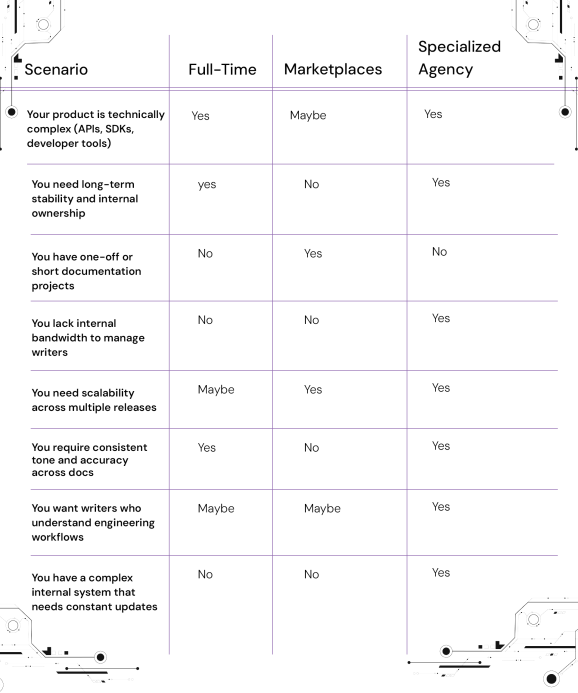
The most important factor not covered in this table is cost. It influences every hiring decision and determines how sustainable each model is over time. The true cost of documentation is not just what you pay per hour or per project. It includes management time, review cycles, and the effort needed to maintain accuracy as your product evolves.
What does it cost to hire a technical writer?
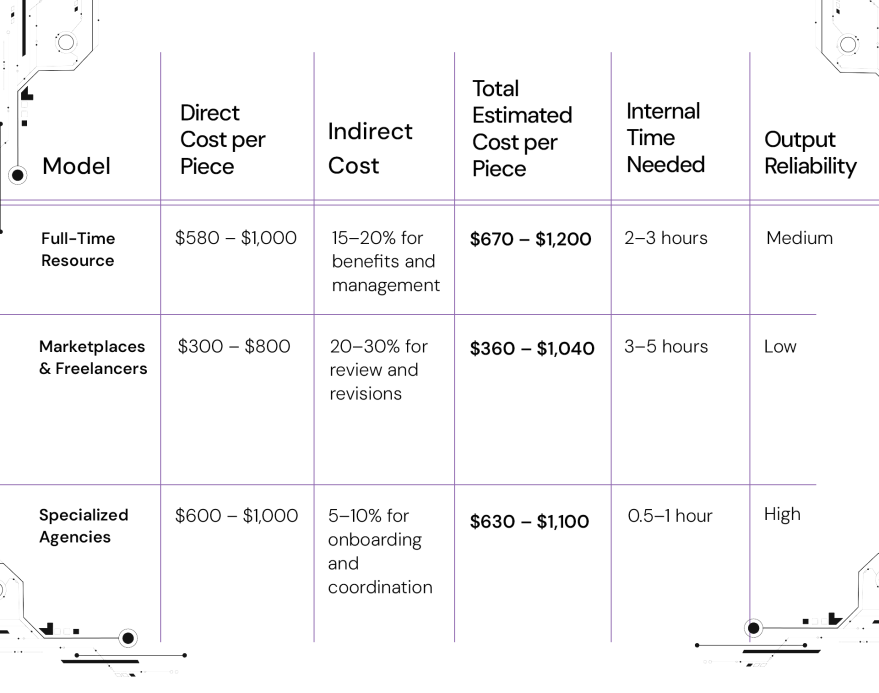
The cost of hiring a technical writer depends on the model you choose and the amount of internal time required to manage the process. To make the comparison meaningful, this section breaks down the total cost of producing one content piece, such as a tutorial, guide, or documentation module. All estimates are based on industry data, current salary benchmarks, and assumptions for developer-focused teams.
Cost logic and assumptions
1. Full-time resource
The median salary for a technical writer in the United States is $91,670, according to the U.S. Bureau of Labor Statistics. Industry sources place this range between $70,000 and $120,000 for writers working in technical or developer-facing roles.
Developer documentation takes longer to produce due to research, validation, and testing. Assuming a full-time writer produces six content pieces per month (72 per year), the direct cost per piece comes to $580-$1,000. Adding 15-20% for benefits, software, and management brings the total estimated cost per piece to $670-$1,200.
2. Marketplaces and freelancers
Freelance technical writers charge between $30 and $100+ per hour, or $0.30-$0.75 per word, based on experience and project complexity. For a 1,000-1,500-word documentation piece, this equals $300-$800 in direct cost.
With 20-30% extra time for reviews, rework, and coordination, the total estimated cost per piece is $360-$1,040.
3. Specialized agencies
Agencies that handle end-to-end documentation, technical writing, editing, and review typically charge $0.40-$0.70 per word, depending on technical depth and delivery timelines. This results in a direct cost of $600-$1,000 per piece for a 1,200-1,500-word deliverable.
Adding 5-10% for onboarding and internal alignment brings the total cost per piece to $630-$1,100. Since agency writers are typically engineers, the internal time needed from your team is minimal, often under one hour per piece. If you are looking to outsource technical writing, this guide covers when and how to make that decision.
Total documentation cost framework (TDC Framework)
(Cost to produce one technical content piece)
Key takeaways
- The total cost per content piece between a full-time writer and a specialized agency is similar once you include management time and indirect costs.
- Agencies handle project management, editing, and alignment internally, which reduces time spent by your product and engineering teams.
- Marketplaces appear cheaper initially but require more supervision and review, which increases total effort and cost over time.
- For developer tool companies, where accuracy and documentation updates are continuous, the agency model delivers the best cost-to-output ratio with consistent reliability and lower internal effort.
What the right choice looks like in practice
To hire a technical writer, you first need to understand what you are hiring for. Short-term projects, ongoing documentation, API references, knowledge bases, and documentation maintenance all require different levels of investment and expertise. Budget, internal bandwidth, product complexity, and release velocity will help determine whether an in-house hire, freelancer, or agency is the best fit.
For many SaaS and devtool companies, agencies provide the fastest path to execution. A specialized documentation partner brings established processes for research, technical writing, editing, reviews, and content governance, helping documentation stay aligned with product updates as the platform evolves.
When evaluating any documentation partner, technical expertise matters. Writers need to understand developer workflows, APIs, integrations, and the questions developers ask while implementing a product. Without that foundation, documentation often becomes difficult to maintain and less useful to the people it is intended to help.
If you have concerns about working with an agency, including quality control, brand alignment, communication, or visibility into the process, the top 5 fears small teams have about technical writing agencies covers each concern in detail.
Hackmamba is a technical writing and documentation agency that partners with SaaS and devtool companies to create documentation, technical content, API references, tutorials, and developer education resources. Our team combines engineering and technical writing expertise to produce content that aligns with real product workflows and developer needs.
Beyond content creation, we also help distribute technical content through our developer community and developer-focused marketing channels, helping your documentation and educational resources reach the audiences most likely to use them.
If your goal is to build documentation that scales with your product, supports developer adoption, and remains accurate as your platform grows, book a call with us.
FAQs
1, What does a technical writer do?
A technical writer translates complex technical information into clear, usable documentation for a defined audience. For SaaS and developer-tool companies, this typically means API references, integration guides, onboarding docs, tutorials, and internal runbooks. A strong technical writer works closely with engineering and product teams, learns the product deeply, and produces content that reduces the questions developers need to ask before successfully using the platform.
2, What is the best way to hire a technical writer?
The best approach depends on your documentation needs, budget, and release pace. Full-time hires work best for companies with steady, ongoing documentation output and frequent product updates. Freelancers suit short-term or one-off projects. Specialized agencies are the best fit for developer tool companies that need continuous documentation with technical accuracy, managed review cycles, and minimal internal oversight.
3, Where can I find qualified technical writers?
You can source technical writers through LinkedIn Jobs, dedicated job boards like Technical Writer HQ, freelance platforms like Upwork and Toptal, or specialized technical writing agencies. For developer-facing documentation specifically, agencies with engineering-background writers typically produce more accurate output than general freelance platforms, where technical depth varies widely.
4, How do I evaluate a technical writer's skills?
Review writing samples for clarity, accuracy, and structure. Ask the candidate to explain a product feature in their own words or rewrite an existing help article without briefing. Strong technical writers ask precise questions, work independently, and produce error-free drafts. For API or developer documentation roles, check whether they are comfortable with tools like Git, Markdown, and OpenAPI.
5, Should I hire a full-time writer or a freelancer?
Hire full-time if you have a consistent, high volume of documentation work tied to regular releases. Use freelancers for defined, project-based tasks where the scope is clear and you have internal reviewers available. If neither fits, an agency gives you the structure of a full-time resource with the flexibility of a freelancer, at a comparable total cost once management overhead is factored in.
6, What should I include in a technical writer job description?
Include the specific deliverables (API docs, integration guides, tutorials, internal runbooks), technical domain knowledge required, tools and workflows used (Git, Markdown, Notion, Confluence), collaboration expectations with engineering and product, and whether the role is full-time, contract, or project-based. Be specific about the product and audience: "developer documentation for a payments API" attracts better candidates than "technical writing role."
7, How much does it cost to hire a technical writer?
Full-time technical writers in the US earn $70,000-$120,000 per year, with total cost per content piece running $670-$1,200 when benefits and management are included. Freelancers charge $30-$100+ per hour or $0.30-$0.75 per word, with total cost per piece at $360-$1,040 after review cycles. Specialized agencies typically cost $630-$1,100 per piece with significantly less internal management time required.
8, When should a company hire its first technical writer?
The clearest signal is when engineers or product managers are regularly interrupted to answer documentation questions, when developer onboarding takes longer than it should, or when support tickets repeatedly cover topics your documentation should address. If any of those are happening at consistent volume, the cost of a technical writer is almost always lower than the cost of the engineering time being lost.